Disaster Research & Training Centre (DRT)
The Federal government of Somalia (FGS) reinstated the Somali Disaster Management agency (SoDMA) in 2022, with a mandate to consolidate the functions of the Agency and ensure the implementation of key objectives, in which humanitarian response and recovery remains a central pillar in the administration’s main six pillars. This arrangement assumes an important principle that underpins the Administration’s core priorities: to implement the goals of the government with efficiency and transparency. Therefore, aligning priorities with key strategic pillars of the Government is essential for creating recovery opportunities in this post-conflict stage in Somalia. With a deeper understanding root cause of the complex challenges facing the nation’s recurrent disasters (Floods, Droughts, and other manmade disasters, the current setup of the agency will help address those challenges with an emphasis on efficiency and high standard professional ethics that will determine the historic legacy of the Institution as we go forward. The Somali Disaster Management agency (SoDMA) is established to provide direction and leadership in serving the national interest and promoting sustainable humanitarian response coordination through policies, programs, education, and interaction with local communities, government, and non-government institutions. Disasters whether natural or manmade affect many critical resources and services of a nation. Natural hazards are the main source of risk for the poor and present a serious obstacle to achieving sustainable social and economic development. Disasters affect the poor most severely; measures are taken to manage hazards and reduce their impact provide an effective vehicle to make substantial advances in the fight against poverty. The negative effects though cannot be prevented, the impact of disasters on communities, livestock, and infrastructure can be mitigated. The scope of disaster management is quite wide and it extends over development, prevention, preparedness, response, relief and rehabilitation, and mitigation. All these phases require effective research and the discharge of key functions and assumptions of certain roles. The roles can at times be primary, especially when a crisis takes place and certain other functions become secondary which become supportive to the primary functions. Somalia in general is one of the most disaster-stricken states in the Horn of Africa. Due to the accumulation of people and assets in hazardous places, many communities living across the country are increasingly facing vulnerability to the impacts of natural and manmade hazards, Airport road, E-mail: Commissioner@sodma.gov.so Mogadishu, Somalia particularly with persistent droughts, floods, and an armed conflict between clans and government and Al-Shabab militias. In light of this background, the Research and Training department will be realized through basic, applied, developmental scientific research in the field of disaster risk management and performs the function of capacity building for effective and efficient disaster risk management. The Research and Training department conducts research on natural hazards such as Drought, Floods, Tropical Cyclones, etc. It also performs relevant and appropriate Disaster research, data analysis and collating, and preparing appropriate reports, briefs and documents containing evidence-based assessments
Vision
- To be the Institute of Excellence in Disaster research and training in Somalia by 2029.
Mission
- Generate quality DRM data and evidence through enhancing the capacity of SoDMA staff and its stakeholders in collaborative DRM research and training interventions
- Serve as a center of knowledge and information exchange and networking point for SoDMA and its stakeholders.
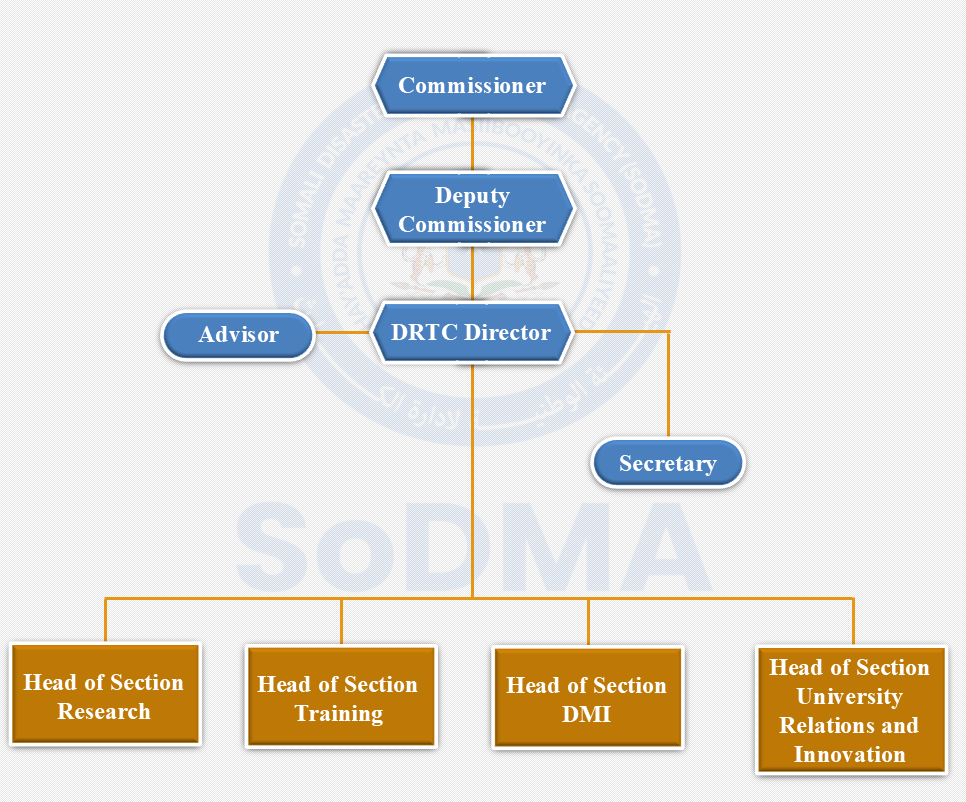
Main Roles and Responsibilities
- Conducting research on hydrological hazards and carrying out studies on risk reduction of hydrological hazards.
- To be SoDMA Training coordination point.
- Conducting quantitative data analysis of existing disaster secondary data sets and primary quantitative data, using Excel and/or SPSS.
- Preparing disaster research papers and reports as assigned; documents, reports, and present research findings to Commissionaires
- Presents results of analysis in a clear and concise manner, orally, in writing and graphically;
- Producing high quality research reports, briefing papers and discussion papers ensuring that the reports are authoritative, meet defined needs and quality standards that are capable of withstand challenges and scrutiny.
- Conducting institutional capacity needs assessment of the SoDMA staff.
- Based on findings from the SoDMA institutional capacity needs assessment, develop a capacity development plan and ensure its timely implementation.
- Identifying and proposing priority training and capacity sessions staff.
- Preparing training plan based on the prioritized training needs
- Preparing Disaster research road map and training curriculum
- Developing training modules for priority courses
- Establishing training hubs at federal and state levels
- Defining collaborative Disaster research priority areas with key stockholders
- Maintaining clear records and data on all trainings and capacity building sessions § Determining appropriate methods of data collection and analysis, such as surveys, interviews, focus groups, or statistical models
- Presenting Disaster research findings to management in an understandable manner
- Documenting the process of post-disaster reconstruction and rehabilitation in the country.
- Translating, writing, and publishing books related to Disaster risk management.